Community and Resources
Finding the Hidden Network
A documented journey through public interest technology and computing career resources, written day by day as I actually went through the process.
Why this guide exists and what makes it different
Most career guides give you a list of resources and tell you to go explore them. This one documents what actually happened when I did that, what I found, what confused me, what surprised me, and what felt useful versus what felt like noise.
This guide also connects to something bigger. This summer I am contributing to a research paper, "Beggars Can't Be Choosers" and Other Barriers to Ethics-Aligned Careers for Recent College Graduates in Computing, that studies exactly the problem I am living through: what happens when computing students who care about ethics try to find careers that actually reflect those values. The paper finds that the job market has structural barriers built into it, that computing departments push students toward prestige paths rather than values-aligned ones, and that even students who know what they want feel powerless to find it. Writing this guide is part of trying to address that gap, to make visible the network of information that exists but is genuinely hard to find.
Before I started: where I was
Going into this, I had already used LinkedIn, Indeed, and Handshake extensively. I had signed up for a software engineering job list that sent me postings every day, sometimes more than 1,000 during peak season. Most of what I applied to through those channels either ghosted me or sent a rejection. I was overwhelmed and confused, and I was not sure if the problem was my applications, my qualifications, or the fact that I was looking in the wrong places for the wrong things.
I also knew, after doing the research that went into the other guides in this series, that the kind of work I actually wanted, something at the intersection of technology and people, Human-Computer Interaction research, public interest technology, policy-adjacent roles, was not going to show up easily on the platforms I had been using. That kind of work lives in a different corner of the internet, behind communities and newsletters and networks that you have to actively find.
This guide documents what I found when I went looking for that corner.
What the research says about why this is hard
The paper I am contributing to this summer found something that matches my experience directly. Computing departments legitimize prestige-seeking careers and make it structurally difficult for students to find alternatives. The information about public interest technology, civic tech, and mission-driven careers is not on the same recruiting infrastructure as Big Tech. Students who want those paths have to do the work to find them entirely on their own, outside the department, without the same career center support or recruiting pipeline.
Kirdani-Ryan, Ko, and Borisova (2023) found that computing students whose values conflicted with departmental norms faced considerable effort to find alternatives and had to do that work largely outside the department. This is what I experienced. Nobody pointed me toward All Tech Is Human or benzevgreen.com. I found them through research for this project. That is exactly the structural gap the paper documents.
The information exists. It is just scattered, and you have to know where to look. That is what this guide is trying to help with.
Signing up for All Tech Is Human
The first thing I did was sign up for the All Tech Is Human Slack community, which I had been putting off since it was on my task list at the very start of this summer. Here is exactly what the process looked like.
Step 1: Find the sign up page
Go to alltechishuman.org and look for Resources, then the Slack Community. Or go directly to alltechishuman.org/slack-community.
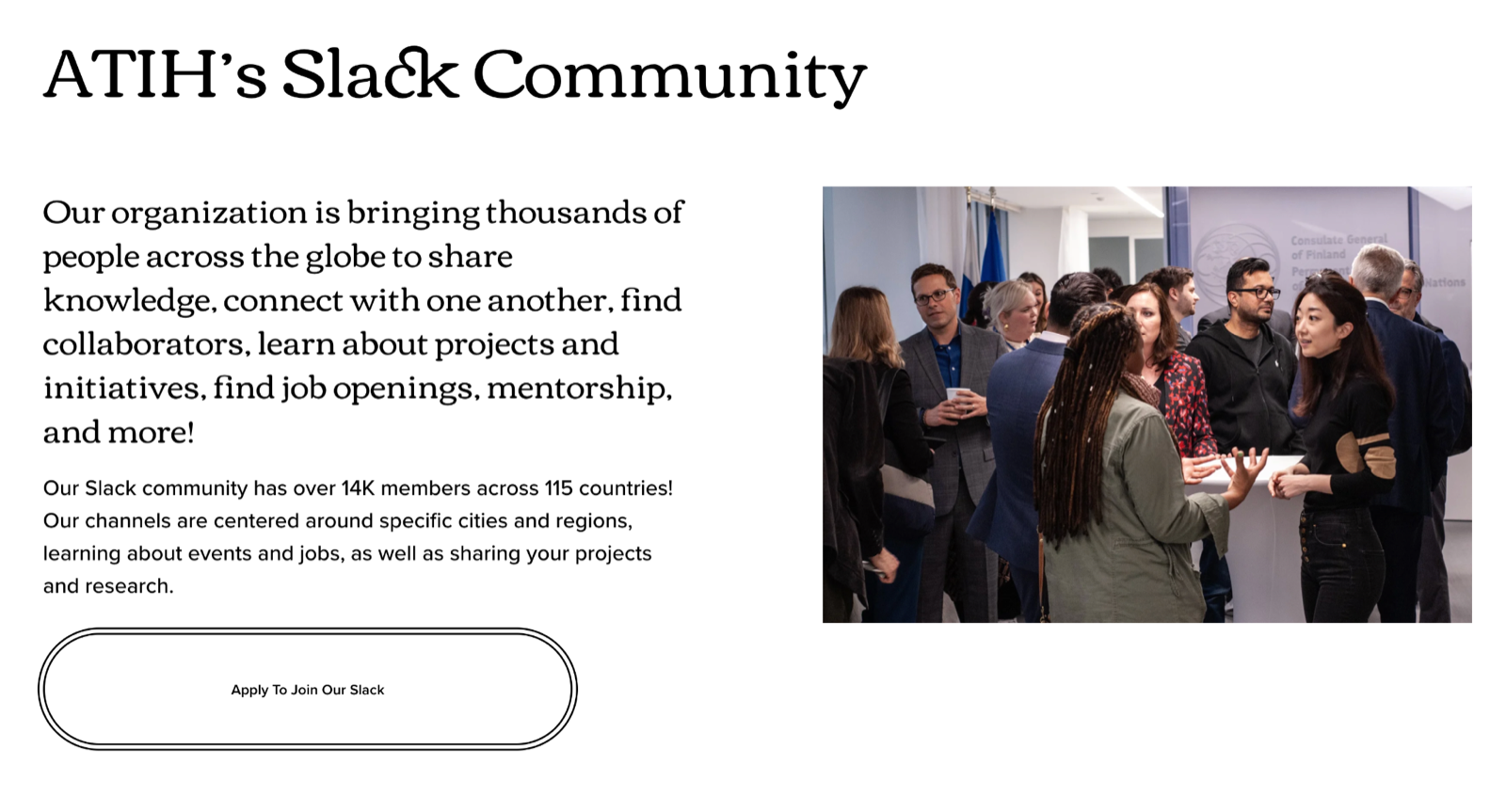
Link: alltechishuman.org/slack-community
Step 2: Fill out the application form
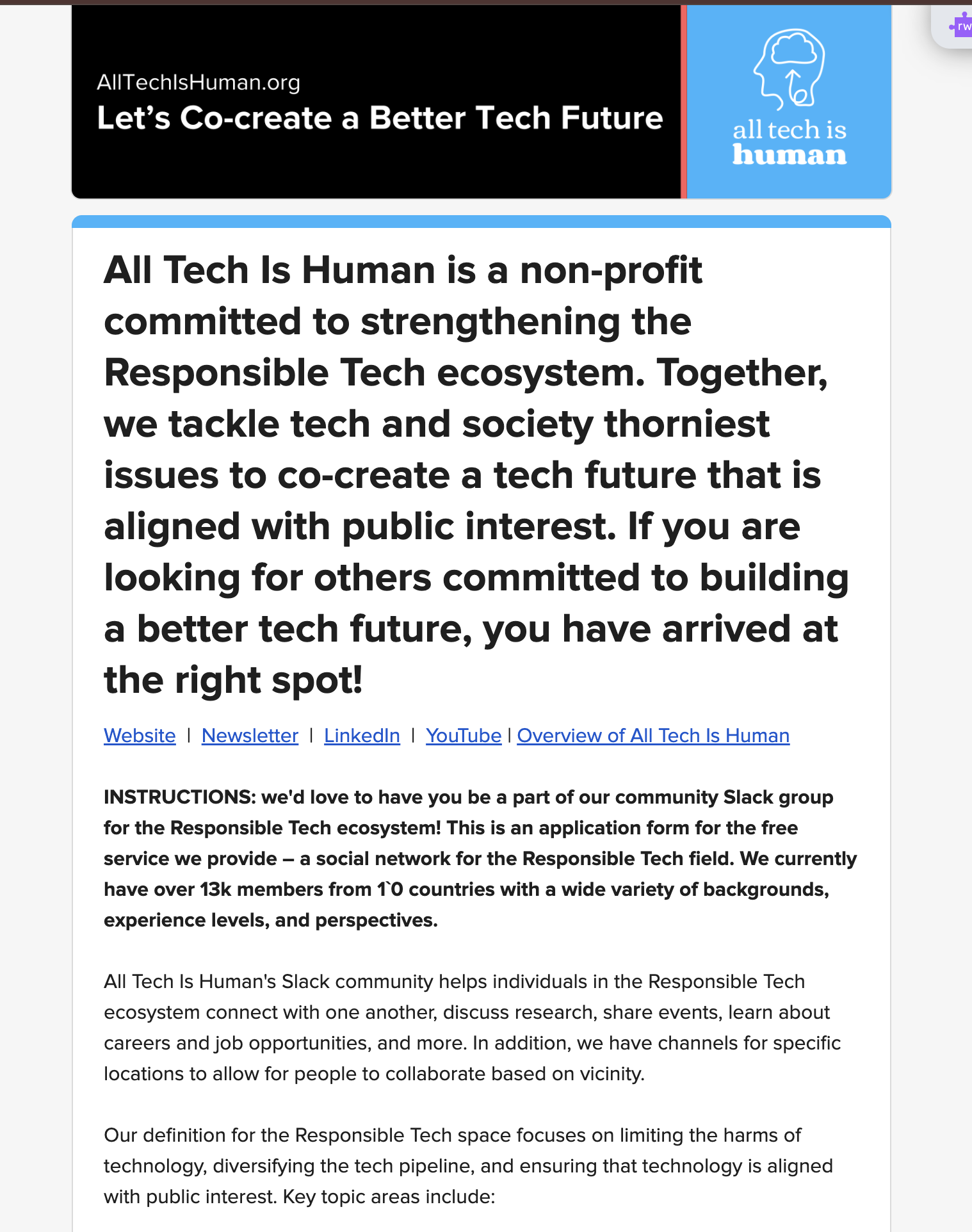
The Slack community is not open to anyone, you have to apply. Click "Apply to join our Slack," which takes you to a Google Form. The form asks your name, your professional background, your interest in responsible tech, and what you hope to get out of the community.
Step 3: Wait for approval and check your email
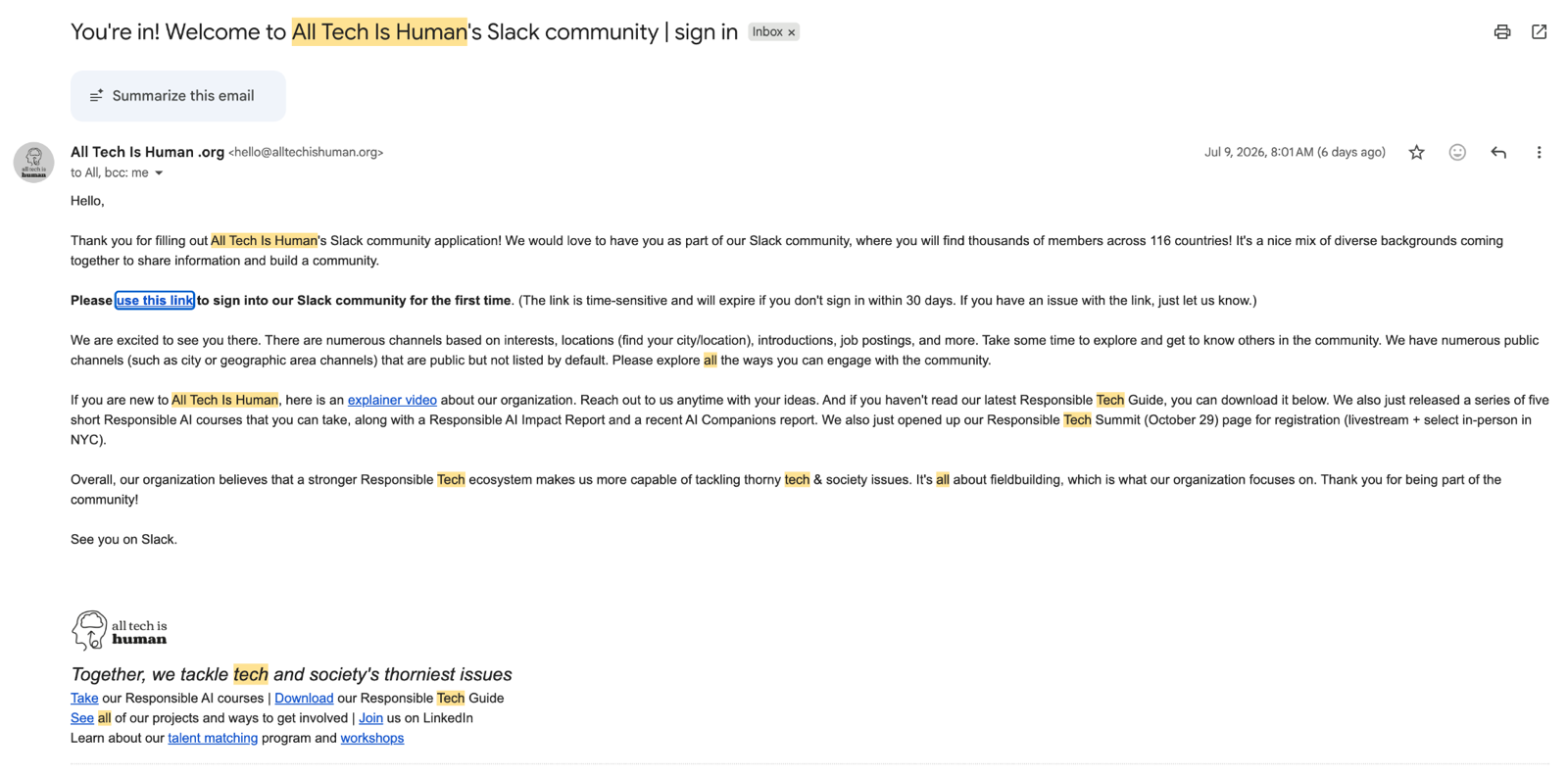
After submitting the form you wait to be approved and receive an invitation link by email.
Step 4: Explore what is inside
Once inside, the community has channels organized around specific cities and regions, job opportunities, events, projects and research, and specific topic areas within responsible tech. There is also an onboarding document that walks you through how to navigate the community.
The workspace describes itself as a home base for thousands of people across the globe to share responsible practice, connect with one another, find collaborators, learn about projects, and access mentorship and initiatives. The channels are organized around specific cities and regions, around learning about events and jobs, and around sharing your own projects and research.
Link: alltechishuman.org/slack-community
Finding jobs inside the Slack community: step by step
Getting approved is only step one. Here is exactly what I saw once I was in and what I actually clicked to get to the postings.
Step 5: Look at the channel list in your sidebar
You do not have to search for the jobs channel. Once you are approved, the workspace drops a set of default channels straight into your left sidebar under "Channels." Mine included introductions-and-community-building, all-tech-is-human-info-and-questions, celebrations-and-shout-outs, events-and-happenings-in-responsible-tech, general-discussion-on-responsible-tech, job-postings-careers-in-responsible-tech, nyc-community, offer, responsible-ai-conversations, tech-policy-conversations, upskilling-in-responsible-tech, and youth-tech-and-wellbeing-conversations. There is also a "Browse all channels" link at the bottom if you want to see ones you have not joined yet.
Step 6: Click into the job-postings-careers-in-responsible-tech channel
This is the real, current name of the channel: job-postings-careers-in-responsible-tech. When I checked, it had over 15,000 members in it alone, which is more people than are in most entire Slack communities, let alone one channel.
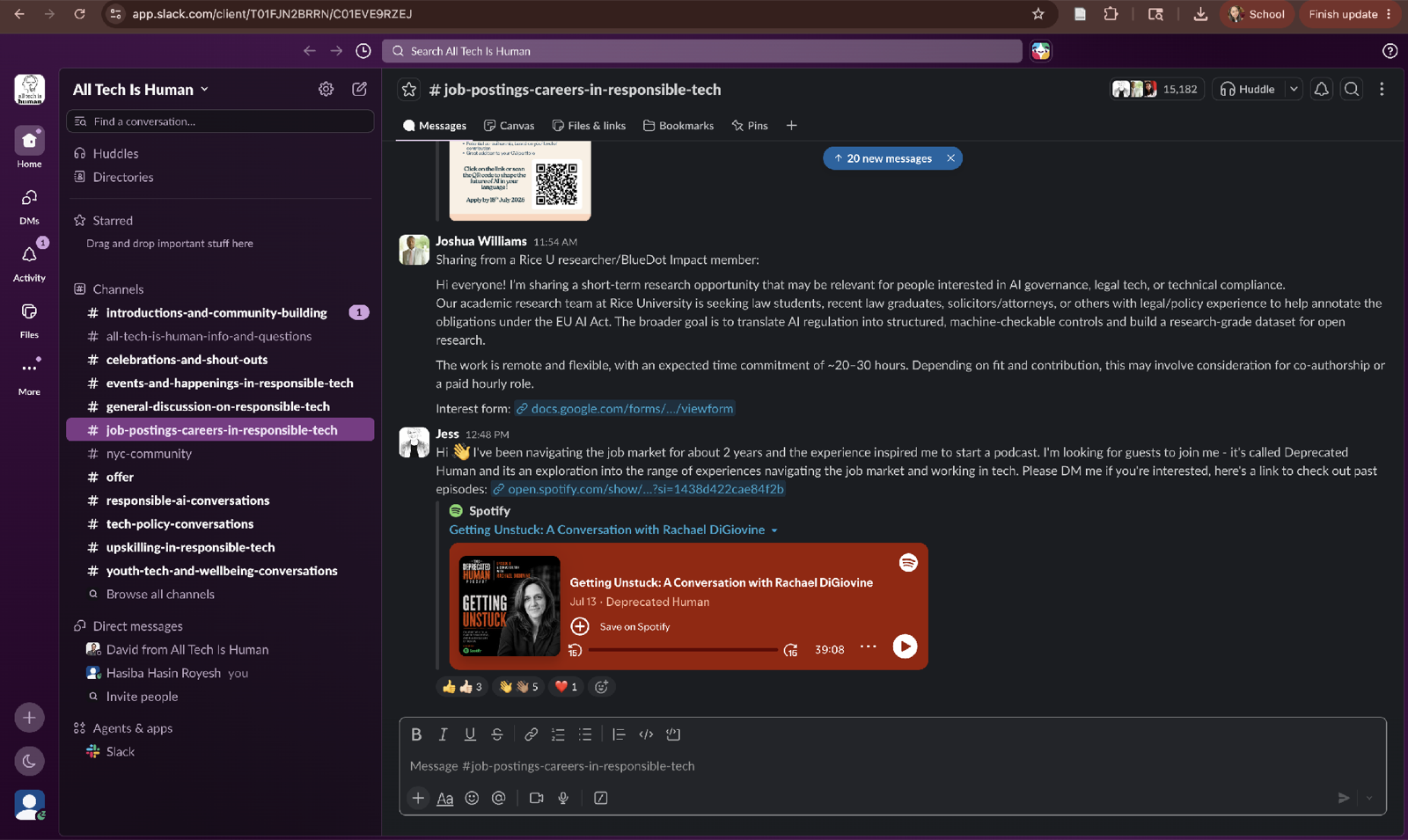
Step 7: Read the pinned posts and use search for a specific role
Click Pins at the top of the channel to see anything the moderators have pinned, and use the search bar at the top of Slack, not just scrolling, to search within the channel for a keyword like a role title or "remote." A channel this size moves fast enough that scrolling alone will make you miss things.
Step 8: Turn on notifications for that one channel only
Click the channel name at the top, open notification preferences, and set it to notify you on every new message for just that channel. Leaving your notifications on the workspace default means a new posting gets buried under conversation from over 15,000 people.
Step 9: Respond inside Slack, not only through an outside link
When a post includes an outside link to apply, apply there, but if the person who posted is active in the workspace, a short reply or direct message referencing the actual post tends to get more attention than a form submission alone. Keep it as short as the recruiter email format later in this guide.
There are more communities and opportunities inside the workspace beyond that one channel. The events-and-happenings-in-responsible-tech channel surfaces conferences and webinars, which are their own kind of opportunity. The nyc-community channel, with about 2,600 members, is one of several city and region specific channels, and it is genuinely active, while I was in it, people were sharing things like a happy hour for local signatories of a tech accountability pledge and the full program for a two day gathering on accountable tech design happening during New York City Design Week, with a registration link right in the post. The offer channel, with almost 14,000 members, works differently, it is where people post what they can give rather than what they need, things like free coaching calls for people building something new, consulting availability for organizations that need it, or an open invitation to collaborate on and give feedback on a project someone is building. The responsible-ai-conversations, tech-policy-conversations, and upskilling-in-responsible-tech channels are topic specific spaces where people share projects, resources, and, informally, openings that never make it to the jobs channel at all. Worth a look even on a day you are not actively job hunting.
My full assessment of All Tech Is Human
The positive: this is genuinely one of the most useful communities for students interested in public interest technology and responsible tech. It is where people doing this work actually talk to each other, share opportunities that never make it to LinkedIn, and offer mentorship. It is free. It connects you to a global network of practitioners.
There is also a bi-monthly Responsible Tech Careers newsletter you can subscribe to separately at responsibletechcareers.substack.com that delivers job listings directly to your inbox, which means you do not have to check the job board manually.
The negative: the application process creates a small barrier and you will need to put in some initial time to orient yourself once inside rather than getting immediate value on day one. The community is large, which means it takes some navigation to figure out where the most useful conversations for your specific situation are happening.
Update since joining: I have now been approved and I am in the Slack community. The job-postings-careers-in-responsible-tech channel is real, with over 15,000 members in it. I can see actual opportunities being shared directly by the people posting them, not just recycled links from other job boards. Before I was approved I could only describe what the website promised. Now I can confirm it from the inside.
Another resource I found: the Mozilla Student Resource Guide
While doing this research, my professor pointed me toward the Mozilla Student Resource Guide, a living document maintained by the Mozilla community meant to be an entry point into responsible computing generally. It is not specific to job searching the way All Tech Is Human is, but it is one of the more comprehensive single documents I have come across. It covers what responsible computing actually means, how the Mozilla Foundation itself is structured, ways to get into open source through resources like Codetribute and the Mozilla Developer Network Learning Area, and a long section on finding a responsible computing job that lists fellowship programs, job boards, non-university affiliated institutes, and reading lists.
What makes it useful is that it is community maintained and updated on a rolling basis, so it tends to catch things that a single person's research would miss. It is also a good example of the same idea this guide is built on: the information exists, but it lives in a document you have to already know to look for.
Other things I found on the All Tech Is Human site
- Responsible Tech Job Board (alltechishuman.org/responsible-tech-job-board) filters jobs by field, experience level, region, and whether visa sponsorship is available. That last filter is something I have not seen on LinkedIn or Indeed and it matters a lot for international students.
- Responsible Tech Talent Pool (airtable.com/app4wbkLF0RdB6Q6D/shraPI2t5xhCfYmbc), separate from the job board, where you can add your name and be matched with roles.
- LinkedIn Learning course "Responsible AI Foundations Professional Certificate" that is free through All Tech Is Human's partnership with LinkedIn.
Exploring the job boards and what I actually found
Next I spent time going through public interest technology and responsible tech specific job boards alongside the general ones I had been using, specifically to compare what shows up where.
What I already knew about general job boards
LinkedIn, Indeed, Handshake, and Bucknell Connect are where most students start. They work well for certain kinds of roles, large tech companies, software engineering positions, business analyst roles. They are not designed for the public interest technology and responsible tech ecosystem. The volume is high, the signal is low, and the application process is so standardized that it is very hard to stand out or even know if your application was seen by a human.
Bucknell Connect is Bucknell's own alumni and career networking platform, and it is worth using specifically because the people on it already have a Bucknell connection, which makes cold outreach feel less cold. It is smaller than LinkedIn, but that is part of the point.
The software engineering job list I subscribed to sent over 1,000 postings on peak days. That sounds like abundance but it actually creates a different problem: you cannot meaningfully evaluate 1,000 postings. You start filtering by name recognition and salary and applying in bulk, which produces exactly the outcome I experienced, mostly silence.
What the public interest technology specific job boards are like
The All Tech Is Human job board is structured differently. It is smaller, which at first feels like a limitation but is actually a feature. Every listing is in responsible tech by definition. The filters let you narrow by field, Responsible Artificial Intelligence, Trust and Safety, Public Interest Technology, Tech and Democracy, Youth Tech and Wellbeing, which means you can find roles actually aligned with what you care about.
benzevgreen.com/jobs focuses specifically on fellowships and entry-level roles in public interest technology. This is worth bookmarking separately because fellowships are a significant entry point into this kind of work and they are almost entirely invisible on general job boards.
techjobsforgood.com aggregates jobs at mission-driven tech organizations. Smaller than LinkedIn but the signal to noise ratio is much better for someone looking for values-aligned work.
Justice Tech (justicetech.download), written by Jason Tashea, is a weekly newspaper focused specifically on the intersection of justice and technology, courts, legal aid, and criminal justice reform. It is narrower than the others, but if that intersection is something you care about, it is one of the only places that consistently surfaces jobs and events in that specific niche.
The most important finding: volume versus fit
This is the most important thing I learned from this research and it connects directly to what the paper we are working on found. The general job market, LinkedIn, Indeed, Handshake, mass email lists, optimizes for volume. The public interest technology and responsible tech ecosystem optimizes for fit. Those are not compatible approaches and using the wrong one for what you are looking for produces frustrating results.
When I was applying broadly to software engineering roles I was competing in a market where the criteria are largely standardized, grade point average, coding challenge ability, internship brand names. I was applying to roles that did not match what I actually wanted, getting ghosted, and wondering if the problem was me. The research we are doing for the paper says the problem is structural: the information and infrastructure for values-aligned careers is hidden behind communities and networks that most computing departments never mention.
The fix is not to apply to more jobs on LinkedIn. The fix is to be in the right communities, subscribed to the right newsletters, and connected to the people who know about opportunities before they are posted publicly, or that are never posted publicly at all.
Navigating the job search: telling real postings from noise
My professor asked me to add this because it came up so often it stopped being a minor annoyance and started being its own skill. A huge number of the postings you find, on any platform, are not actually open in the way they look. Some things I have learned to check.
- Look at the posting date. A listing that has been up for more than 30 to 45 days with no changes is often what people call an evergreen posting, a company keeping the listing open to build a pipeline of resumes rather than actively hiring for a specific opening right now. This is common at large companies for software engineering roles especially.
- Check the company's own careers page. If a role is on LinkedIn or Indeed but is not also listed on the company's actual site, treat that as a signal to look closer. Sometimes it means the role was filled and the third party listing was never taken down.
- Look at the applicant count if it is visible. Hundreds of applicants within days of posting does not mean you should not apply, but it does mean a generic application is unlikely to be seen. This is where a referral or a direct message matters more than the application itself.
- Ask in community spaces before assuming. In All Tech Is Human, people will often tell you directly if a posting is real or if a company is known for posting roles it does not fill. That kind of information does not exist on LinkedIn.
How to actually email a recruiter
I was intimidated by this at first because it felt like something you had to already know how to do. What I have learned is that it works best when it is short and specific.
- Say who you are in one sentence: your year, your school, your major.
- Name the specific role and where you saw it.
- Give one specific, honest reason you are interested in that role or that company, not a generic line about being passionate about technology.
- Ask one specific question, whether there is anything you should know about the role, or whether the position is still open, rather than a vague ask for advice.
- Keep the whole email under 150 words. Recruiters get a lot of these.
- If you do not hear back, one follow up after about a week is normal and expected. More than that starts to work against you.
The people already around you
This is the part I almost skipped because it felt too obvious to write down, but my professor pointed out that students skip it constantly. Professors in your specific area of interest often have their own list of resources that never makes it into a general guide like this one. A data science professor is going to know about internships and job boards specific to data science that I, focused on Human-Computer Interaction and public interest technology, would never find on my own. The same is true across every subfield. Asking a professor directly, do you know of any job boards or programs specific to this area, is a faster path than searching for it yourself.
The Career Center is worth a direct visit for the same reason, but you have to ask for the right thing. Going in and asking generally for job search help gets you generic advice. Going in and specifically asking for resources related to public interest technology, or civic tech, or whatever your specific area is, gets you something closer to what you actually need. I had not done this before writing this guide, and it is on my list now.
What I actually want: thinking about short and long term goals
My professor asked me to include this in the guide because most students, myself included, find it easier to look at job boards than to sit with the harder question of what they actually want. Here is my honest attempt at that.
One year after graduation
I genuinely do not know yet, and I am trying to be honest about that instead of performing certainty I do not have. What I do know is that I am applying for both graduate school and jobs at the same time, which means I am keeping options open rather than committing to one path. The clearest thing I can say is that I want to be doing something that connects technology to people in a way that feels meaningful, whether that is in a graduate program studying Human-Computer Interaction, in a fellowship doing civic tech work, or in a research or policy-adjacent role. I am not willing to do something purely for the title or the salary, which is easier to say than to act on when facing a job market this difficult.
Five to ten years after graduation
This is where it gets more specific for me. I want to be working in a space where I am genuinely contributing to how technology gets built or governed in ways that are more equitable and accountable. That could be as a researcher, as someone working in tech policy, or as someone in a mission-driven organization working on responsible artificial intelligence or public interest technology. The research I am doing this summer, and the graduate programs I am looking at, are all pointing in that direction.
The honest answer to "what do I want to do?"
I am still figuring this out, and I am trying to be okay with that. What I know is that I care about Human-Computer Interaction, about ethics in artificial intelligence, about the people who are most affected by technology and least represented in the rooms where it gets built. I want to end up in work that takes those things seriously. Beyond that I am still exploring, and I think that is a more honest and useful thing to say than pretending I have a five year plan perfectly mapped out.
A framework for thinking about your own goals
Because my professor asked me to help students think through this, here is a set of questions I found useful. These are not a formula, they are starting points for reflection that I think are more honest than most career planning exercises.
Short term (next 1 to 2 years)
What do you want to be doing every day? Not the title, the actual work. What would you need to learn or experience to get there? What are you applying for now and is it actually what you want, or is it what seems safe or expected? Who do you want to be learning from?
Medium term (3 to 5 years)
What kind of problem do you want to have spent years working on? What kind of organization do you want to be part of, its size, its mission, its culture? Do you want to be closer to research or closer to implementation?
Long term (10 years)
What do you want to have contributed? Not for a resume, what do you want to have mattered? Who do you want to have worked alongside and learned from? What would it mean for your work to have been worth doing?
These questions do not have right answers. But sitting with them honestly is more useful than applying to 50 jobs you are not sure you want.
Connecting this guide back to the research
The paper this summer found that students who want values-aligned careers face structural barriers that are not about individual failure. The department legitimizes prestige-seeking. The job market infrastructure is built for traditional tech recruiting. The information about alternatives is hidden behind communities and networks that most students never encounter.
Writing this guide is part of trying to address that structurally. If the research finds that the information is hidden, one response is to make it visible. That is what this guide is trying to do, not just list resources but document the process of finding and using them, including what is confusing or frustrating or slow, so that the next student who goes looking has a clearer path than I did.
The fact that I put off signing up for All Tech Is Human for weeks even after it was on my task list is itself a finding. The barrier was not that I did not know about it, I did. The barrier was the small friction of an application process, the uncertainty about whether it would be useful, and the absence of anyone pointing me toward it as a priority. That is exactly the kind of hidden barrier the paper is about.
Step by step: how to actually get started today
Based on everything documented above, here is the most concrete version of what to do.
- Go to alltechishuman.org/slack-community and fill out the application form. It takes five minutes. Do it now rather than putting it off.
- Once approved, look for job-postings-careers-in-responsible-tech in your sidebar. It is usually there by default, no need to search for it. Open it, check the pinned posts, and turn on notifications for that channel specifically so postings do not get buried.
- Bookmark the Mozilla Student Resource Guide alongside the All Tech Is Human resources. It covers responsible computing more broadly and is kept up to date by the community, so it catches things a single job board will not.
- While you wait for approval, subscribe to the Responsible Tech Careers newsletter at responsibletechcareers.substack.com. This gives you job listings in your inbox without having to check the job board manually.
- Bookmark benzevgreen.com/jobs, techjobsforgood.com, and justicetech.download if the justice tech niche fits your interests. Check them once a week. They update less frequently than LinkedIn but the listings are more relevant for values-aligned work.
- Before spending time on a posting older than a month, check the company's own site. Confirm the role is still actually open before you invest time on the application.
- Send one specific email to a recruiter for a role you actually want this week. Use the short, specific format in the Navigating the Job Search section instead of only submitting through the application portal.
- Look up one person whose career path interests you on LinkedIn. Trace their path backward from where they are now to where they started. What did they do in college? What was their first role? What fellowships or programs did they go through? This is more useful than reading general career advice.
- Sign up for one email newsletter from an organization whose work you find interesting. The Markup, Data and Society, the AI Now Institute, and the Electronic Frontier Foundation all have newsletters. You will start building a sense of the field just by reading what they are working on.
- Email one professor in your specific area of interest and stop by the Career Center. Ask each of them for resources specific to your area, not general advice.
- Set aside thirty minutes to sit with the short, medium, and long term questions in this guide. Write down whatever comes to mind, even if it is vague or contradictory. The goal is not to have answers, it is to start asking the questions before the decision feels urgent.
References
- All Tech Is Human. (2026). Responsible Tech Job Board. alltechishuman.org/responsible-tech-job-board
- All Tech Is Human. (2026). Slack Community. alltechishuman.org/slack-community
- All Tech Is Human. (2026). Responsible Tech Careers Newsletter. responsibletechcareers.substack.com
- Tech Jobs for Good. (2026). techjobsforgood.com
- Bens Green Jobs. (2026). Public Interest Technology Jobs. benzevgreen.com/jobs
- Tashea, J. (2026). Justice Tech. justicetech.download
- Mozilla Foundation. (2026). Mozilla Student Resource Guide. docs.google.com/document/d/1-IlnmJU7YFz9S8lUEHZzwVyp8u-ybOBJDifGmcFiGyk
- Bucknell University. (2026). Bucknell Connect.
- Algorithmic Justice League. (2026). ajl.org
- Noble, S.U. (2018). Algorithms of Oppression: How Search Engines Reinforce Racism. New York University Press.
- O'Neil, C. (2016). Weapons of Math Destruction: How Big Data Increases Inequality and Threatens Democracy. Crown Publishers.
- SignalFire. (2025). State of Tech Talent Report 2025. signalfire.com/blog/signalfire-state-of-talent-report-2025
- Kirdani-Ryan, M., Ko, A.J., & Borisova, E.A. (2023). "Taught to be Automata": Examining the Departmental Role in Shaping Initial Career Choices of Computing Students. Computer Science Education. doi.org/10.1080/08993408.2023.2171689